
Digitalisation and increased efficiency

-
Authorisations
-
FINMA processes a vast number of applications for new authorisations or amendments each year. Thanks to increases in efficiency, driven largely by increasing digitalisation of its processes, FINMA has succeeded in reducing the time required for processing such authorisations in almost every area, despite sharp rises in quantity structures and complexity in some areas.
A current example of this is the field of FinTech, in which the average internal processing time for authorisation enquiries has halved since 2023.

Source: Own calculations
For the last ten years, FINMA has offered a fast-track process to accelerate time-to-market for traditional Swiss investment funds. The average internal processing time for approving Swiss funds, including this fast-track process, was 10 days in 2025 (61 applications) and 12 days in 2024 (73 applications).
The average time for the entire approval process of Swiss funds (incl. external processing by the applicant) is 25 days. In an international comparison, these processing and approval times prove to be particularly short, given that approval of an investment fund in other major financial centres can take an average of over 80 days.
Progress has also been noted in other areas, with a few examples outlined below.
The following graph shows the sharp increase in authorisation applications from insurance intermediaries since 2024. At the same time, after an initial increase in maximum processing days, processing time was significantly reduced in all areas, also thanks to the use of digital solutions.

Source: Own calculations
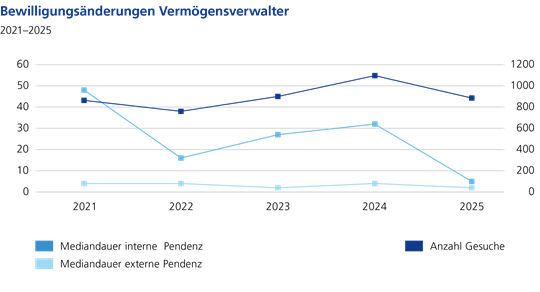
The following graph shows the length of time required for amendments to authorisations for portfolio managers and trustees in days, by year from 2021 to 2025. As the number of licensed institutions has increased, requests for amendments have also increased significantly. Nevertheless, FINMA’s internal processing time is reducing (median duration of internal open cases).
Source: Own calculations
-
Data collected for the first time on all authorised providers of asset and wealth management services in Switzerland
-
In 2025, in what was a major step forwards for data-driven supervision, FINMA collected cross-sector data on the operations of all authorised financial services providers in Switzerland for the first time. The objective was to obtain a uniform and complete market overview of the Swiss asset management sector and be able to identify and address the potential risks better. As at 31 December 2024, the survey showed assets under management totalling CHF 8,772 billion. The largest share of the recorded assets is being managed by banks and investments firms, followed by fund management companies and managers of collective assets. Portfolio managers and insurance companies play a much smaller role in the overall market.
-
Direct collection of liquidity data improves assessment of banks’ risk diversification
-
Since the implementation of the final Basel III reforms as of 1 January 2025, FINMA has been conducting capital adequacy surveys directly with the banks. The data was previously collected by the Swiss National Bank (SNB) and then forwarded to FINMA. In 2026, FINMA will also conduct the risk diversification survey of banks. FINMA attaches great importance to the quality of the data submitted. All submissions are subject to automated validation and consistency checks, supplemented by expert-led supervisory reviews. Irregularities are systematically reviewed and followed up in order to ensure a reliable data basis for supervision.
-
Data Innovation Lab: innovation for data-driven and efficient supervision
-
The Data Innovation Lab is FINMA’s innovation vehicle in the area of data-driven supervision. It identifies and tests new technological approaches and translates them into concrete supervisory applications. The focus is on promoting data-driven, efficient and forward-looking supervisory practice. This strengthens FINMA’s ability to identify risks at supervised institutions at an early stage and understand market conduct better. The Data Innovation Lab’s main responsibility is the Integrated Risk Expertise division, which was created in 2025. It assumes a cross-divisional function and cooperates closely with all FINMA specialist units, gathering ideas from the entire organisation, prioritising them in terms of benefits and impact, and developing them further in a structured process. This results in a balanced portfolio of supervisory initiatives
-
Automating the processing and analysis of account statement data
-
In 2025, FINMA automated the harmonisation, cleansing and visualisation of bank statement data relating to investigations of unauthorised activities. This significantly enhanced the efficiency and quality of the ad-hoc analysis of such data. The processes involved are expected to be used in other areas of FINMA in the future.
-
Use of technology in market supervision
-
FINMA relies on intelligent processes and modern technology to analyse effectively the large number of reports of suspicious activity and data from more than 120 million transaction reports. This enables events which may affect share price to be recorded in a systematic and automated manner and subsequently reconciled with incoming reports of suspicious activity. In cases of suspected insider trading, artificial intelligence also helps to decide whether there is a potential impact on share price, thereby facilitating the efficient triaging of such cases. Furthermore, FINMA used agile methods to develop new tools for assessing and analysing potential sophisticated market manipulation. The tools enable order book and closing data to be graphically illustrated in a holistic manner on a daily basis or, if required, up to microsecond level, and made suitable for use in court.