
Dossier on effective and efficient financial market supervision
FINMA is a lean and efficient organisation that takes a risk-oriented approach and applies proportionality to its supervision. It hardly grew at all from 2012 to 2022. Its growth since 2023 is due to being assigned new responsibilities, the emergence of new topics and new methods, and increasing risks. However, employee numbers at FINMA (FTE in permanent employment) will remain in three figures.
As a regulatory body that is entrusted with oversight of the financial market, FINMA needs a high degree of independence in order to achieve the best outcome for society. Just as a strong, independent central bank ensures low inflation and sustainable growth, a strong and independent supervisory authority reduces the risk and scale of crises in the banking and financial system and therefore serves as the basis for sustainable growth and competitiveness. Studies clearly show: the more independent the supervisory authority, the more stable the financial system.
However, independence certainly does not mean that FINMA should carry out its duties free from supervision and accountability, quite the contrary. Accountability to Parliament is of central importance. In addition, there is also regular communication with the Federal Council as a whole, its finance committee, the Head of the Federal Department of Finance, the Swiss Federal Audit Office (SFAO), the State Secretariat for International Finance (SIF) and the General Secretariat of the Federal Department of Finance (FDF).
FINMA has a broad mandate and many responsibilities. These include client protection, security and stability in the financial centre. As an integrated regulatory body, FINMA capitalises on synergies and performs its mandate efficiently and effectively. |
Who is FINMA?
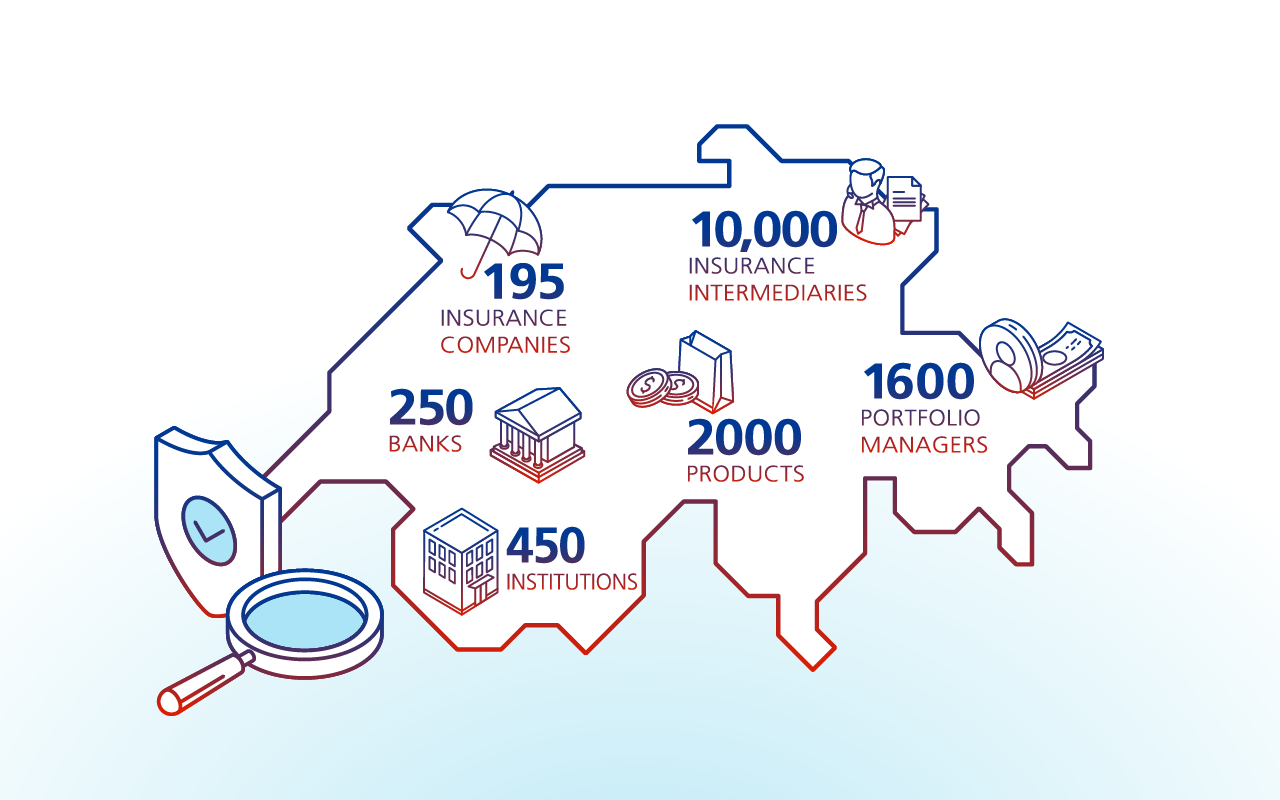
As the independent and integrated authority of one of the most important global financial centres, FINMA is responsible for the supervision of a very large and diverse population of financial institutions.
What is FINMA tasked with?

FINMA is responsible for the authorisation and supervision of a very large and very diverse population of financial institutions, and as such, has been mandated by the legislator to carry out a wide range of tasks. This includes strengthening the resilience of financial institutions, client protection, market integrity, and combating money laundering.
How does FINMA guarantee proportionality in its supervision?

FINMA’s supervision is designed to be risk-oriented and proportional. It carries out the most intensive checks on those financial services providers whose size and complexity pose the greatest risk potential for the financial centre and its clients.
How does the cost of FINMA compare with the benefits it brings in terms of resilience and the integrity of the Swiss financial centre?
FINMA carries out its wide range of responsibilities for the Swiss financial centre with 617 permanent FTEs as at the end of 2025. In time, FINMA will become even more proportionate, efficient and digital.
Digitalisation and increased efficiency
Targeted expansion of data-driven methods and increased usage of artificial intelligence (AI) is strengthening FINMA’s ability to identify risks at an early stage, to monitor market behaviour and improve investor, creditor and policyholder protection. This also means that efficiency levels can be increased in the various authorisation processes.