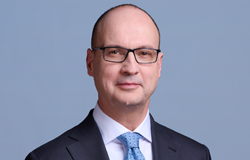
Good morning. As FINMA’s new CEO I am delighted to be making my first public appearance in front of the audience here at the Small Bank Symposium.
Small and medium-sized banks are an essential pillar of the Swiss financial centre, as the lending and deposit business is extremely important for the domestic economy.
But international wealth and asset management is also offered by smaller institutions and creates added value.
So the smaller banks make a significant contribution to the Swiss economy – and usually do so without generating unfavourable headlines.
Three phases of the crisis
A very important part of our work consists in preventing crises as far as possible through the supervisory actions we take.
But if they happen nonetheless, we must be able to manage them effectively. From the supervisory perspective there are three key phases of preparation and intervention.
These apply regardless of whether an institution is big or small.
First there is the phase of calm.
This is when the institutions and the system are operating normally. FINMA oversees institutions on an ongoing basis and intervenes early if needed.
Second, the phase of instability.
Here a crisis is beginning to build and there is growing instability. In this phase FINMA monitors that the institutions deploy the recovery tools they have prepared.
Finally there is the damage control phase.
This is when the crisis is at its peak with no prospect of stabilisation. FINMA ensures that an institution is resolved and exits the market in an orderly manner.
Even this brief sketch of the three phases makes it clear that both of us – you and ourselves – have the greatest freedom of action in the first phase.
Therefore my central message is this: In the end, the stability of the financial system is determined at the beginning – in the phase of calm and early intervention.
Please allow me to develop my thoughts on these three phases a little more.
The phase of calm: building up capability and options for action
In the first phase, the calm phase, normality and stability prevail in the financial system. The goal of supervision is therefore to maintain this phase.
But unfortunately we cannot predict the next crisis, because the economy and the financial system are constantly changing.
The sources of stress and transmission mechanisms in the system are highly complex.
So it is better to build a resilient financial system where supervision aims to minimise the probability and severity of a crisis as far as possible. What we need to strive for – and what I will work towards in the coming months and years with determination – is best-in-class supervision.
This means that we have a full range of instruments and powers at our disposal and deploy these in an efficient and effective way when problems first emerge.
This is the way to act early and preventively against crises and so prevent problems and misconduct from becoming so serious that they jeopardise the stability of an institution or even the entire Swiss financial system.
In other words, FINMA must be able to intervene before the instability phase.
This applies above all to systemically important banks, which can result in excessive and disproportionate risks.
Other large bank supervisors such as the Federal Reserve, European Central Bank and Bank of England – but also smaller ones such as in Singapore – already have the powers to implement all of their supervisory measures early, i.e. during going concern operations.
FINMA lacks many of these opportunities to act at an early stage.
To give one example, FINMA does not have the statutory powers to restrict compensation and dividends if forward-looking stress tests uncover a potential capital hole.
We also need a senior managers regime, the ability to impose fines and must make supervisory proceedings more transparent.
We will therefore advocate for supervisory tools that enable effective early intervention.
Some have raised a concern that powers for FINMA to intervene early would represent undue interference in the free market.
Or that extensive measures should only be taken when an institution enters the instability phase.
But we would counter first that it is often too late to intervene at this point, as there may already have been a sharp outflow of liquidity or even a bank run.
Furthermore we would point out that banks are different from other companies by virtue of the fact they can be systemically significant.
They therefore require more stringent regulation.
Hence there are already some relatively far-reaching government interventions in the market, for example deposit insurance.
The more effective and proactive supervision is, the less market-distorting interventions we will ultimately need.
Second, FINMA needs to use its existing and new tools and powers in a best-in-class manner.
As I have experienced, FINMA has a highly professional, motivated, innovative and collaborative team.
We will draw the lessons from the last crisis, both in Switzerland and globally, to develop further and improve.
As discussed, the focus will be on preventive supervision and thus on early intervention.
Our task is to identify risks and be proactive to remediate problems and unsound practices as quickly as possible.
We will do this even more deliberately in future.
We will strengthen our supervisory activity and tools to enable us to identify weaknesses in risk culture, corporate governance and business models early and in an even more targeted way.
The crises of recent years, particularly at Credit Suisse and other banks that got into difficulties, have highlighted that the most serious problems typically begin with an inadequate risk culture.
This leads to dysfunctional corporate governance and ultimately results in a business model that is not sustainable.
It is only later that capital and liquidity problems become visible.
But at this later date intervention to correct the problem is usually more difficult.
That is exactly why it is essential that FINMA has the necessary powers and capabilities to intervene early to address unsound practices.
We must also ensure – together with the SNB and of course the financial institutions themselves – that institutions are resilient against both financial and non-financial shocks.
We must ensure they have sufficient capital and liquidity.
These safety buffers need to provide very high coverage of the risks.
We will also develop further our tools in the area of stress tests.
These assess whether capital buffers are adequate in difficult economic scenarios.
Moreover, we challenge the financial institution’s assumptions for the business outlook through an ongoing and intensive capital planning dialogue. We critically evaluate the development of the capital position, including planned distributions.
Finally we also have to focus on non-financial risks.
These are growing and can be serious enough to destabilise a financial institution.
The financial institutions need good risk management and well-designed processes to manage these risks, for example to ward off cyber attacks or survive the outage of a critical service provider.
But business conduct also needs to be beyond reproach, particularly in avoiding risks relating to money laundering, market abuse and sanctions.
Our supervision will continue to monitor these areas very closely.
The instability phase: recovery by the institution itself
To return to the three phases I set out at the beginning, in the second phase – the instability phase – the backdrop is one of widespread uncertainty or an incipient crisis.
In this phase, best-in-class supervision is about ensuring that an institution has the required resources and options to pull itself out of a crisis.
This can apply to any bank that experiences turmoil.
At the systemically important banks, this is achieved via credible and ready-to-implement recovery plans.
These help the financial institution to bolster its liquidity and capital position in a crisis.
In the interests of prevention we will test the assumptions, implementability and effectiveness of these plans even more rigorously under potential future stress scenarios.
The recovery plans must be realistic and capable of being implemented in practice.
For a recovery plan to be successful, it is therefore essential that it was properly prepared in the first phase, i.e. the period of calm.
Senior management is obliged to focus on the recovery plan during the calm phase.
The damage limitation phase
In the damage limitation phase, the supervisor’s task is to oversee the orderly resolution of an institution, protecting depositors and minimising the damage.
Best-in-class supervision must aim to ensure that the resolution of the institution remains a realisable option. In the case of UBS, for example, there would no longer be an alternative, such as a takeover by another bank, in the event of a crisis
.
We therefore need to work towards ensuring that UBS is resolvable.
The CS crisis starkly illustrated the vulnerability of the parent banks.
We will therefore focus particularly intensively on this entity.
In the case of UBS we support full capitalisation of the parent bank’s subsidiaries.
Beyond this we will strengthen the resolution plans of the systemically important institutions and seek to ensure they are capable of being implemented under various scenarios.
Above all in the case of UBS we will review the business model and structure of the merged bank with regard to its resolvability from the outset.
In this context we must have powers to prevent business activities, practices or interdependencies that could hinder an effective resolution of the institution.
In addition there is a link between resolvability and capital buffers at group level:
The more difficult it is to resolve a bank, the higher the precautionary capital buffers need to be.
We will keep a very close eye on this.
Again it is critical that resolvability is prepared in the phase of calm.
Conclusion: preparation and resilience are everything
As my discussion of the different phases of preparation and intervention illustrates:
To be effective, FINMA’s supervisory efforts need to be shifted forward to the first phase.
Early intervention avoids supervisors, and in extreme cases the government, having to intervene much more radically later on.
We have to invest during the phase of calm.
The game is won at the beginning.
This is a challenge to the banks, supervisory authorities, the Swiss Federal Council and parliament.
Above all we have to ensure that the measures discussed in the TBTF report are implemented effectively and as quickly as possible.
It is also obvious that large and systemically important banks need tighter regulation and supervision than the small banks represented here today.
Therefore our supervisory requirements are proportionate to the risk.
We want it to stay that way.
The problems of the bigger institutions should not lead to over-regulation of the small institutions.
This is the philosophy underlying our small banks regime.
Simple, conservative rules enable a lower burden of supervision and intervention.
It means lower implementation costs for smaller banks.
I can promise you that we will maintain proportionality in our supervision.
Therefore our watchword remains: supervision must follow risk.
In summary, FINMA needs the powers to intervene early in the phase of calm.
We then have the responsibility to use these powers in a consistent and targeted way.
Based on this, my vision for FINMA is to secure best-in-class supervision in Switzerland for the future, building on the lessons of the CS crisis and other global developments.
And finally, we will be transparent.
We will communicate more proactively where we see new risks, what we are doing to prevent them and how we have performed.
We will also communicate proactively if there is a need for new regulation to address the risks in an ever-changing financial system.
As FINMA CEO I am firmly convinced that in the end, the resilience of the Swiss financial system is decided at the beginning – in the phase of calm and early intervention.
Thank you very much.